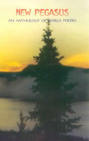
New Pegasus, the latest Global Poetry Anthology by Cyberwit, allows the poetry lovers to relish the most spectacular poems across the world. Few things are more frightening than war, and dark clouds of smoke spilling over the still horizon. No doubt, together the poets create a better world, and ensure Peace through their compositions. The intensity, a genuine emotional depth, the freshness and directness of style of the poets included in New Pegasus. make this book the greatest achievement of the authors. The concept of the global village has expanded the sensibility of several poets of New Pegasus, and they recover their voice in the primitive Mother Nature, like Hucklebery finding respite in a raft. Several poets of New Pegasus are influenced by William Carlos Williams, Pound, T. S. Eliot, Wallace Stevens, Robert Lowell, Roethke, Sylvia Plath, French symbolists including Laforgue, Corbiere, Mallarme and Valery. New Pegasus represents quality and variety, featuring distinctive poetic voices of authors world-wide. Here are the very best poems by so many poets and so many cultures, promoting Peace and Friendship all over the world. Cyberwit's newest New Pegasus is a Quality Book.
All the world's a stage,
And all the men and women merely players:
They have their exits and their entrances;
And one man in his time plays many parts,
His acts being seven ages.
PREFACE
The great depth of contemporary poetry is evident in the poems by Robert Frost, Wallace Stevens, T. S. Eliot, Ezra Pound, Marianne Moore, e. e. cummings, Robinson Jeffers, H. D. (Hilda Doolittle), Robert Graves, W. H. Auden, Archibald MacLeish, Basil Bunting, Robert Lowell, Philip Larkin, Stephen Spender, and others. This anthology New Pegasus is a careful compilation of the international poets with both modern and post-modern characteristics. The modernity of some poets selected for New Pegasus is revealed by the artist's failure in a society quite indifferent and callous to poetry. The disillusionment and predicament of a poet was truly described in Pound's Hugh Selwyn Mauberley: "His true Penelope was Flaubert. He fished by obstinate isles." The artist's private break-down and disintegration was very aptly shown by T. S. Eliot in The Waste Land:
On Margate Sands,
I can connect
Nothing with nothing.
The broken fingernails of dirty hands,
My people humble people who expect
Nothing.
Several poets in New Pegasus have employed 'hard, dry image' to unravel the 'futility and anarchy' of present society. Their images are clearly visualized, concise, precise, and accurate in detail. Pound says, "An image is that which presents an intellectual and emotional complex in an instant of time." By a deft use of such images, the poets would be able to create poems like classic Chinese lyric and Greek epigram. Several poets of New Pegasus have employed symbols, 'the verbal pattern to a pattern of experience'. Blake remarked: "A symbol is, indeed, the only possible expression of some invisible essence, a transparent lamp about a spiritual flame." Due to the use of symbols in many poems in New Pegasus, the authors are able to reveal "esoteric affinities with primordial Ideas."
The importance of symbols was very well understood by W. B. Yeats, the chief representative of symbolism in 20th century poetry. Yeats says: "I have no speech but symbol, the pagan speech I made Amid the dreams of youth." The influence of Rilke, Valery, Mallarme, Rimbaud and Baudelaire is visible in several poets of the New Pegasus. "The purpose of rhythm, it has always seemed to me, is to prolong the moment of contemplation, the moment when we are both asleep and awake, which is the one moment of creation, by hushing us with an alluring monotony, while it holds us walking by variety, to keep us in that state of perhaps real trance, in which the mind liberated from the pressure of the will is unfolded in symbols" (W. B. Yeats).
The post-modern elements, which we find in several poets of New Pegasus, are visible in the impact of mass media. Baudrillard says that simulations are more important than images. "We have now moved into an epoch where truth is entirely a product of consensus values, and where science itself is just the name we attach to certain modes of explanation" (Norris, What's Wrong with Postmodernism, 1990).
We notice 'a systematic skepticism' in many poets of New Pegasus, who avoid 'authoritative definitions' of any event, but they also seem to be supporting world peace, environment and feminism. I have tried my best to include in this anthology New Pegasus only those poets whose poems have deep feeling, exquisite sense of form, and a deep contemplation of the subject originating from the inmost recesses of thought.
|

 Items in cart - View Cart